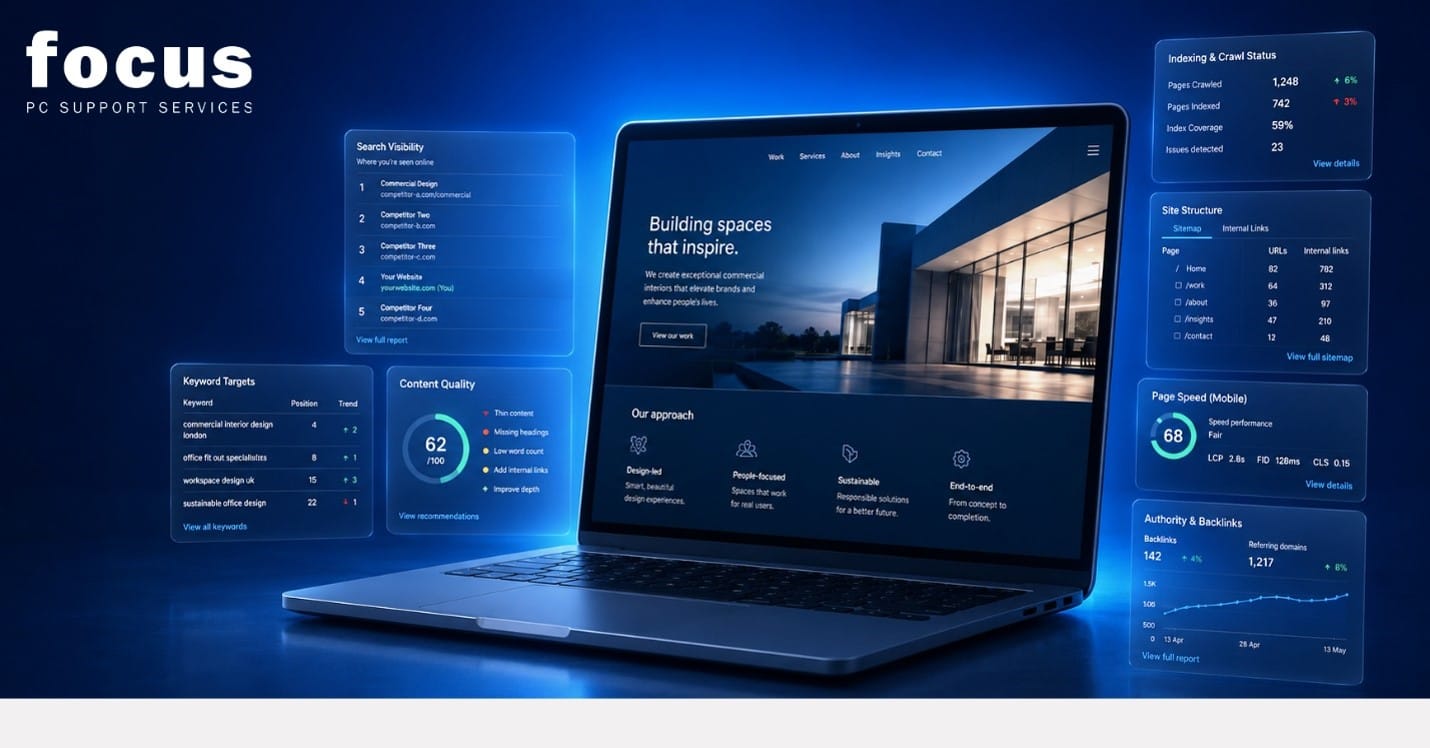
You have invested in a beautiful, fast, and user-friendly website. Yet, when you search for your core services, your business is nowhere to be found. It is a common frustration for UK business owners asking, “why my website is not ranking on Google?”
A visually appealing site is a great foundation, but design alone does not guarantee visibility. To understand why a website is not showing on Google, we must look at how search engines evaluate relevance, authority, and technical health. Here is a practical guide to the hidden reasons your site might be struggling and how to address them.
1. Good Design Does Not Automatically Create Search Visibility
Visual design, branding, and usability are incredibly important for converting visitors once they arrive. However, Google must also be able to access, understand, and evaluate the website’s underlying structure.
A website can look modern and function perfectly on the surface while still suffering from weak keyword targeting, hidden indexing barriers, or thin content. Search engines do not “see” your website the way a human does; they read code and text. If your design prioritises aesthetics over clear, readable content and logical site architecture, search engines will struggle to rank it.
2. The Website Targets the Business, Not the Searcher
Many businesses write website copy using vague, internal language. Phrases like “innovative solutions”, “complete digital services”, or “customer-focused technology” sound professional but do not match what potential customers actually type into a search bar.
People search for specific services and locations. For example, they search for:
- Managed IT support London
- Laptop repair Kensington
- Microsoft 365 support for small businesses
- Gaming PC repair
- Computer repair callout service
Understanding search intent is critical. Each important service should have a focused page that matches a clear user need, answers common questions, and tells the visitor exactly what to do next.
3. Important Pages Cannot Be Crawled or Indexed
Technical SEO issues can silently prevent Google from discovering or correctly interpreting your pages. If search engines cannot crawl your site, they cannot rank it.
Common website indexing problems include:
- Accidental noindex tags left over from development
- Incorrect robots.txt rules blocking important folders
- Broken internal links creating dead ends
- Missing or outdated XML sitemaps
- Duplicate pages confusing search engines
- Incorrect canonical tags
- Slow loading times and poor mobile usability
- JavaScript rendering problems hiding content from bots
- Broken pages and server errors
Furthermore, website redesigns and migrations can severely damage rankings if valuable URLs are removed or changed without implementing proper 301 redirects.
4. The Content Is Too Thin, Generic or Repetitive
A strong SEO content strategy requires pages to have enough useful, original information to satisfy the searcher. A page with just a few sentences and a contact form will rarely rank well.
A strong service page should include:
- The customer’s specific problem
- The service being offered
- How the process works
- Areas covered
- Relevant experience and expertise
- Frequently asked questions
- Trust signals (accreditations, reviews)
- A clear call to action
Avoid creating multiple location pages with almost identical content where only the town name changes. Local pages should include genuinely useful, unique information about the service and the specific area you are covering.
5. Blog Posts Compete with Service Pages
Keyword cannibalisation happens when several pages on your website target the exact same search phrase. This makes it difficult for Google to identify which page is the most relevant, often resulting in neither page ranking well.
Blog posts should support your commercial service pages, not compete with them. They should answer related, informational questions and naturally link readers towards your main service. For example, an informative blog post about preventing ransomware should link naturally to your dedicated cybersecurity or managed IT support services page.
6. The Website Has Weak Internal Linking
Internal linking helps both visitors and search engines understand the relationship and hierarchy between your pages. A well-linked site guides users logically through their journey.
Effective internal linking means:
- Blog posts should link to relevant services
- Service pages should link to related location pages
- Location pages should link to contact or booking pages
- Case studies should link to the specific services involved
- Important pages should never be isolated or orphaned
Always use clear, descriptive anchor text. Repeatedly using generic phrases like “click here” wastes a valuable opportunity to tell search engines what the linked page is about.
7. Local SEO Signals Are Incomplete
For companies serving specific towns, boroughs, or regions, local SEO for small businesses is essential. An attractive website may still lose visibility to competitors with stronger, more consistent local signals.
Crucial local elements include:
- Google Business Profile optimisation
- Consistent business name, address, and phone (NAP) information
- Accurate opening hours and service areas
- Genuine customer reviews
- Relevant local landing pages
- Accurate directory listings
- Local business mentions and clear contact information
If your website says you are in one location, but your directories and profile say another, search engines will struggle to trust your local relevance.
8. The Website Has Limited Authority
Google considers signals beyond your website itself to determine trust and authority. If you want to improve Google rankings, you need relevant links and mentions from other reputable sources.
Valuable authority signals come from:
- Industry websites and professional associations
- Local organisations and chambers of commerce
- Suppliers and partners
- Reputable directories
- Local news publications
- Useful guest contributions
- Genuine case studies and resources
Avoid purchasing large quantities of irrelevant or automated backlinks. A smaller number of relevant, trustworthy links from genuine local or industry sources is far more valuable than hundreds of poor-quality directory submissions.
9. Page Titles and Search Results Do Not Encourage Clicks
Even if your page appears on the first page of search results, weak page titles and meta descriptions can severely reduce your traffic. If users do not click, your rankings can stagnate.
Write clear titles that communicate the service, location, and core benefit without resorting to keyword stuffing. Your meta description should act as a compelling advert for your page. Improving your click-through rate should always be based on actual search performance data, testing what resonates best with your audience.
10. SEO Requires Ongoing Measurement and Improvement
Search engine optimisation is not a one-time feature added during website design; it is an ongoing process. The digital landscape and search algorithms constantly evolve.
Effective management requires monitoring:
- Search queries and keyword positions
- Organic landing pages and click-through rates
- Indexing problems and technical errors
- Enquiries and conversions
- Competitor performance
- Google Business Profile activity
This evidence should guide your decisions. Data might tell you to improve a low-click title, expand a weak service page, fix sudden indexing problems, or build more authority around a page that is already gaining impressions.
Conclusion: Finding Out why my website is not ranking on Google
A great-looking website needs technical accessibility, focused content, local relevance, useful internal links, and credible authority to perform well in search. If you are asking yourself, “why my website is not ranking on Google?”, the answer usually lies in addressing these foundational elements rather than just tweaking surface-level design.
If you need expert help, Focus PC provides practical SEO services UK alongside comprehensive website and IT expertise. We help businesses build a sustainable online presence through:
- Technical SEO audits
- Keyword and search-intent research
- Service and location page optimisation
- Internal linking improvements
- Google Business Profile optimisation
- Website performance improvements
- Content planning
- Competitor analysis
- Link-building strategy
- Conversion tracking and reporting
At Focus PC, our recommendations are always based on measurable opportunities and solid data, never on guesswork. Contact us today to find out how we can help your business achieve the visibility it deserves.