
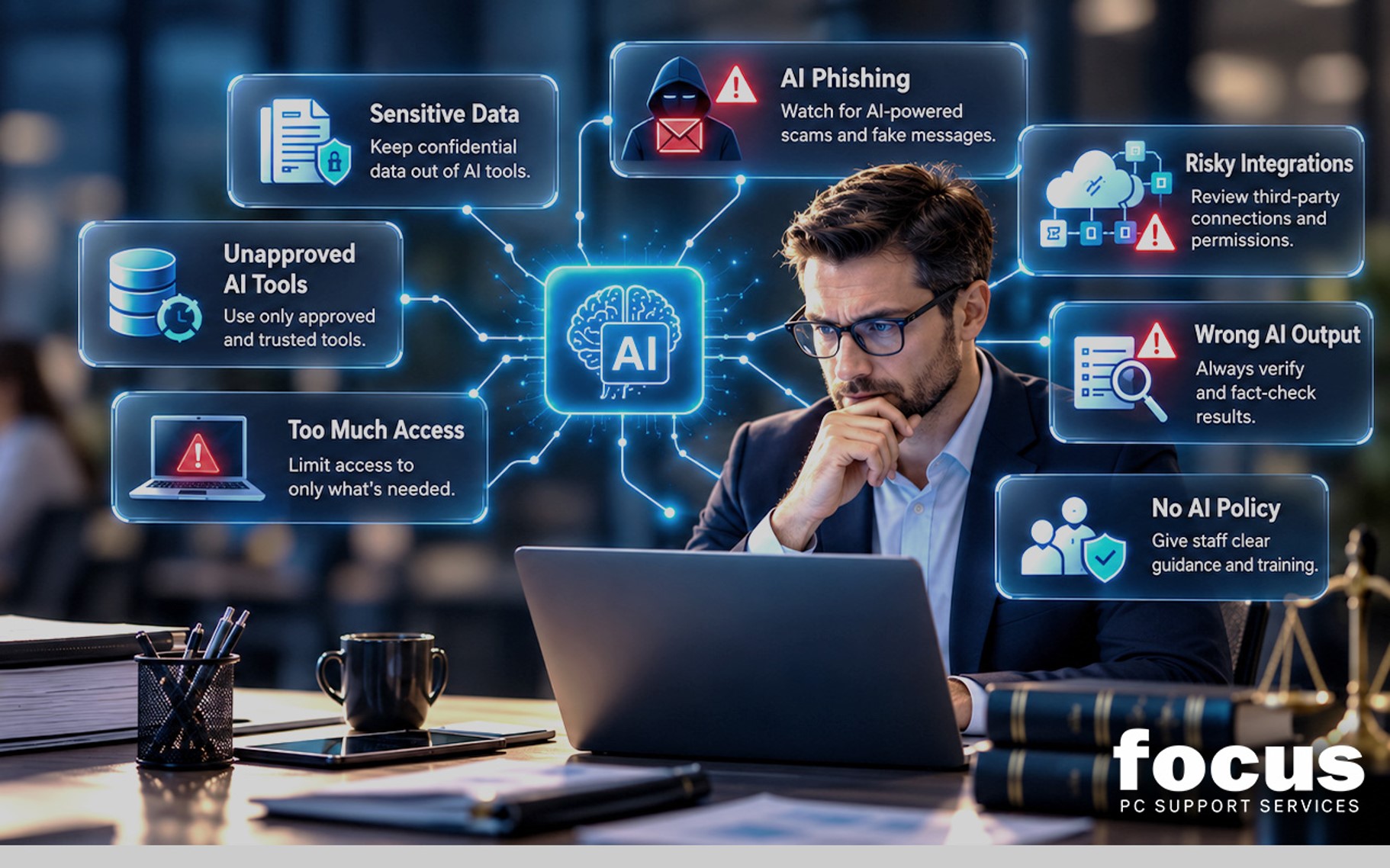
Artificial intelligence is changing how businesses work. From drafting emails to summarising documents, AI tools help employees complete everyday tasks faster.
However, using AI without proper security measures can expose sensitive company information and create new cybersecurity risks.
For UK businesses adopting AI, understanding these risks is essential.
Here are seven common AI security risks for businesses and practical ways to reduce them.
1. Sharing Sensitive Business Data with AI Tools
Employees may unknowingly enter confidential information, customer details or internal documents into AI applications.
Depending on the platform and its settings, that information could be retained or processed in ways your business has not approved.
How to reduce the risk:
Establish clear rules about what employees can share with AI tools. Use approved platforms and review their privacy and data-handling policies before uploading sensitive information.
2. Employees Using Unapproved AI Applications
Many employees experiment with AI tools without informing their employer.
This creates a visibility problem, as businesses may not know which applications are being used or where company information is going.
How to reduce the risk:
Maintain a list of approved AI tools and provide employees with suitable alternatives.
Make it easy for staff to request new applications so they do not need to rely on unapproved services.
3. AI Accessing More Company Information Than Necessary
Some AI assistants connect directly to business documents, emails and cloud storage.
If employees have excessive access permissions, these tools may expose confidential information that should be restricted.
How to reduce the risk:
Review access permissions across Microsoft 365, SharePoint and other connected platforms.
Limit sensitive files to authorised employees and regularly remove unnecessary access rights.
4. Trusting Incorrect AI-Generated Information
AI tools can produce convincing answers that contain inaccurate figures, misleading explanations or invented information.
When employees rely on these responses without checking them, mistakes can affect business decisions and client communications.
How to reduce the risk:
Treat AI-generated content as a starting point rather than a verified result.
Always check important facts, financial information and technical recommendations before using them in business operations.
5. AI-Powered Phishing and Impersonation
Cybercriminals can use AI to create realistic phishing emails, fraudulent messages and convincing voice impersonations.
These attacks may appear professional and contain fewer obvious warning signs than traditional scams.
How to reduce the risk:
Train employees to recognise suspicious requests, particularly those involving payments, passwords or confidential information.
Verify unusual instructions through a trusted communication channel rather than relying on the original message.
6. Unsafe AI Integrations and Third-Party Applications
Connecting AI tools to email accounts, cloud storage and business applications can improve productivity.
However, some integrations request access to more information than they need, increasing security risks.
How to reduce the risk:
Review permissions before connecting AI applications to company systems.
Limit access wherever possible and regularly remove unused integrations.
7. No Clear AI Security Policy
Without workplace guidelines, employees may use AI tools differently and make inconsistent decisions about sensitive information.
This can create confusion over which applications are permitted and who is responsible for managing risks.
How to reduce the risk:
Create a simple AI usage policy covering approved tools, data protection, employee responsibilities and incident reporting.
Provide regular training so staff understand how to use AI productively and securely.
How Can Businesses Use AI More Securely?
Businesses do not need to avoid AI to protect their information. The goal is to adopt useful technology while maintaining appropriate security controls.
Start by reviewing the AI tools your employees already use, identifying sensitive information and checking existing account permissions.
For SMEs, a practical approach to AI cybersecurity should combine staff awareness, secure applications and regular reviews of how AI connects to business systems.
IT Security for SMEs in London
AI can improve productivity, but businesses need to understand how new tools affect their existing security environment.
With over 25 years of IT experience, Focus PC provides IT support and cybersecurity services to businesses across London, helping organisations manage technology risks and strengthen everyday security.
Whether your business is introducing AI tools or reviewing its existing systems, our team can help assess security requirements and identify practical improvements.
Is your business using AI without a clear security strategy?
Explore Focus PC’s Security Services or contact our team to discuss your business IT security requirements.