

The landscape of business connectivity is constantly evolving. As we look toward the future of business connectivity, discussions within the technology sector are already shifting toward the next major leap in mobile networks. While 5G is still being rolled out across the UK, researchers and telecommunications companies are actively exploring what comes next.
Understanding the potential intersection of AI and 6G technology is essential for forward-thinking IT managers and business owners. Although these developments are still in their early research stages, grasping the basic concepts will help you prepare your infrastructure for the decades ahead.
What Is 6G?
6G is the commonly used name for the mobile network generation expected to follow 5G. It is important to clarify that 6G is currently in the research and standards-development stage. Commercial deployment is generally discussed for around 2030 and beyond, meaning specific capabilities are not yet confirmed.
However, current research highlights several potential goals for the future of 6G networks. These include:
- Higher network capacity to support vastly more data.
- Lower latency for near-instantaneous communication.
- More reliable connectivity in diverse and challenging environments.
- Better energy efficiency to support corporate sustainability goals.
- Support for larger numbers of connected devices simultaneously.
- Improved links between terrestrial, satellite and private networks, potentially bringing high-speed coverage to remote and rural UK locations.
Please note that specific speeds, exact launch dates and final technical features are not guaranteed. The technology is still being defined.
Why AI Could Be Built into 6G Networks
As networks grow to support billions of connected endpoints, they may become too complex to manage through manual processes and fixed rules alone. This is where artificial intelligence in telecommunications becomes highly relevant.
Rather than simply being an application that runs over the network, AI could become a fundamental part of the network’s core operation. AI-powered networks could potentially help operators:
- Analyse changing demand in real time.
- Predict equipment faults before they cause outages.
- Allocate network resources dynamically.
- Redirect capacity to busy locations automatically.
- Reduce energy use during quiet periods.
- Detect unusual traffic patterns that might indicate a cyber threat.
- Optimise connectivity automatically without human intervention.
- Improve overall network reliability before users even notice a problem.
By embedding intelligence directly into the infrastructure, networks could become self-healing and highly adaptive.
What AI and 6G Technology Could Mean for Businesses
When we consider 6G business technology, the potential applications span across many different industries. While not every business will experience dramatic, overnight changes, improved reliability and intelligent connectivity could still significantly reduce downtime and support distributed teams.
- Manufacturing: Factories could use highly responsive robotics, advanced business automation and digital twins to simulate and optimise production lines in real time.
- Healthcare: Organisations could better support remote diagnostics and seamlessly connect a vast array of medical devices, ensuring critical patient data is transmitted without delay.
- Logistics: Companies could track vehicles, equipment and assets much more accurately, optimising routes and improving supply chain visibility.
- Retail: Stores could connect hundreds of sensors, security cameras and automated checkout systems to create a seamless customer experience and manage inventory effortlessly.
- Construction and Engineering: Firms could utilise connected heavy equipment and real-time site data to improve safety, monitor progress and manage projects.
- Offices: Standard business environments would benefit from more dependable cloud applications, flawless video conferencing and highly productive remote working setups.
Cloud Computing, Edge Computing and Smart Devices
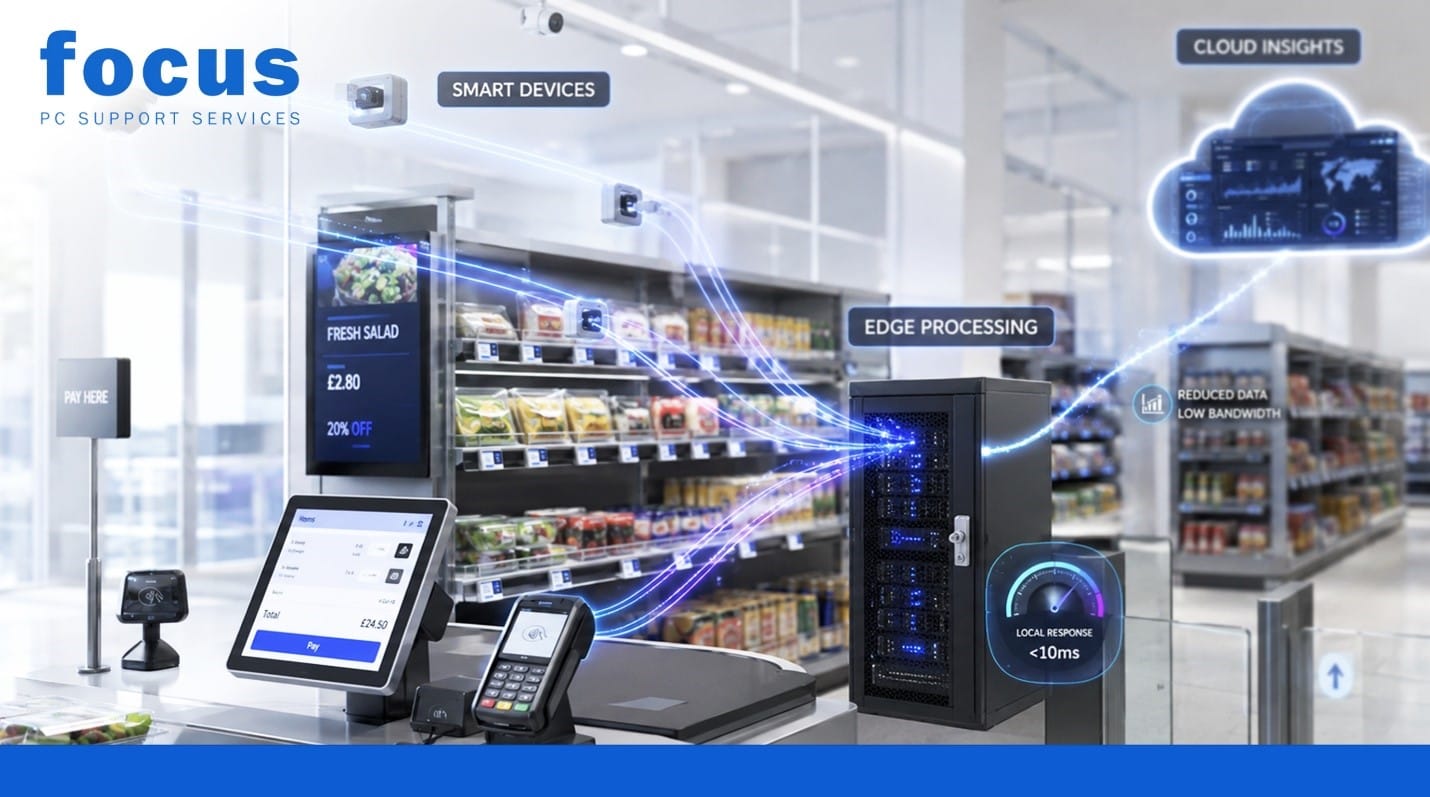
The true power of future networks will rely on how well they integrate various computing environments. 6G could vastly improve communication between central cloud computing platforms, local edge computing systems, sensors and smart devices.
Edge computing involves processing information closer to where it is created, rather than sending all data to a distant central server. This approach helps applications respond much faster.
For example, a retail store’s automated checkout system can process video data locally to speed up transactions, while only sending summary sales data to the central cloud. This reduces the amount of data sent back to central servers, saving bandwidth and improving overall system responsiveness.
Security and Privacy Challenges
Highly connected and AI-managed networks may also create new cybersecurity and privacy risks. Adding more connected devices without proper controls could significantly increase a company’s exposure to cyber threats.
To protect sensitive business information, organisations must prioritise:
- Strong device authentication to ensure only authorised hardware can connect.
- Robust identity and access management (IAM) protocols.
- Comprehensive data encryption for information in transit and at rest.
- Secure software updates to patch vulnerabilities promptly.
- Continuous network monitoring to spot anomalies.
- Regular reviews of automated AI decisions to prevent biased or erroneous actions.
- Strict network segmentation to prevent compromised smart devices, such as a vulnerable smart thermostat, from accessing wider business systems.
Should Small Businesses Prepare for 6G Now?
It is crucial to understand that small businesses do not need to purchase products marketed as “6G-ready” today. Such claims are largely premature. Instead, focus on practical preparations that are useful now and will naturally support future technology.
- Replace unsupported devices and outdated operating systems.
- Improve business Wi-Fi to ensure strong, reliable local coverage.
- Adopt secure and scalable cloud services.
- Use multi-factor authentication (MFA) across all business accounts.
- Strengthen identity controls for all staff members.
- Create a clear technology upgrade plan with a defined lifecycle for hardware.
- Improve cybersecurity policies and provide regular staff training.
- Review backup and disaster-recovery arrangements regularly.
- Keep networks and devices properly managed.
Businesses with outdated hardware, weak security or unreliable networks will not automatically benefit from future connectivity, regardless of how advanced the external network becomes.
Avoiding Technology Hype
In the technology sector, it is easy to get caught up in the excitement of the next big thing. However, businesses should not chase every new technology trend.
Instead, companies should evaluate future technology based on practical criteria: security, tangible business value, compatibility with existing systems, total cost of ownership, reliability and actual operational requirements. If a new technology does not solve a specific business problem or improve a core process, it may not be worth the investment, no matter how impressive the marketing materials appear.
Conclusion
The ongoing research into AI and 6G technology suggests a future where automation, connectivity, cloud services, smart devices and business operations are more deeply integrated than ever before. While commercial networks of this calibre are likely still several years away, the foundational principles of intelligent, highly responsive networks are already shaping how IT strategies are developed today.
Preparing for the future does not mean buying into hype; it means building a robust, secure and scalable IT foundation right now. If you are looking to future-proof your organisation, Focus PC can help. We assist UK businesses in improving their current IT infrastructure while planning sensibly for future technological shifts.
Our comprehensive services include IT infrastructure assessments, business Wi-Fi improvements, cloud and remote-working solutions, managed IT support, device management, cybersecurity, Microsoft 365 support and technology upgrade planning. Contact Focus PC today to ensure your business is built on a reliable foundation, ready for whatever the future of connectivity brings.