

The next evolution of high performance computing has officially arrived. PCIe 7.0, the latest generation of the Peripheral Component Interconnect Express standard, has now been finalized, pushing bandwidth to an astonishing 512 GB/s. While that number may sound highly technical to everyday users, the impact behind it is significant.
From AI infrastructure and cloud computing to next generation GPUs and ultra fast SSDs, PCIe 7.0 represents a major leap forward in how computers move data internally. As modern workloads become increasingly dependent on real time processing and massive datasets, the need for faster communication between hardware components has never been greater.
What Is PCIe?
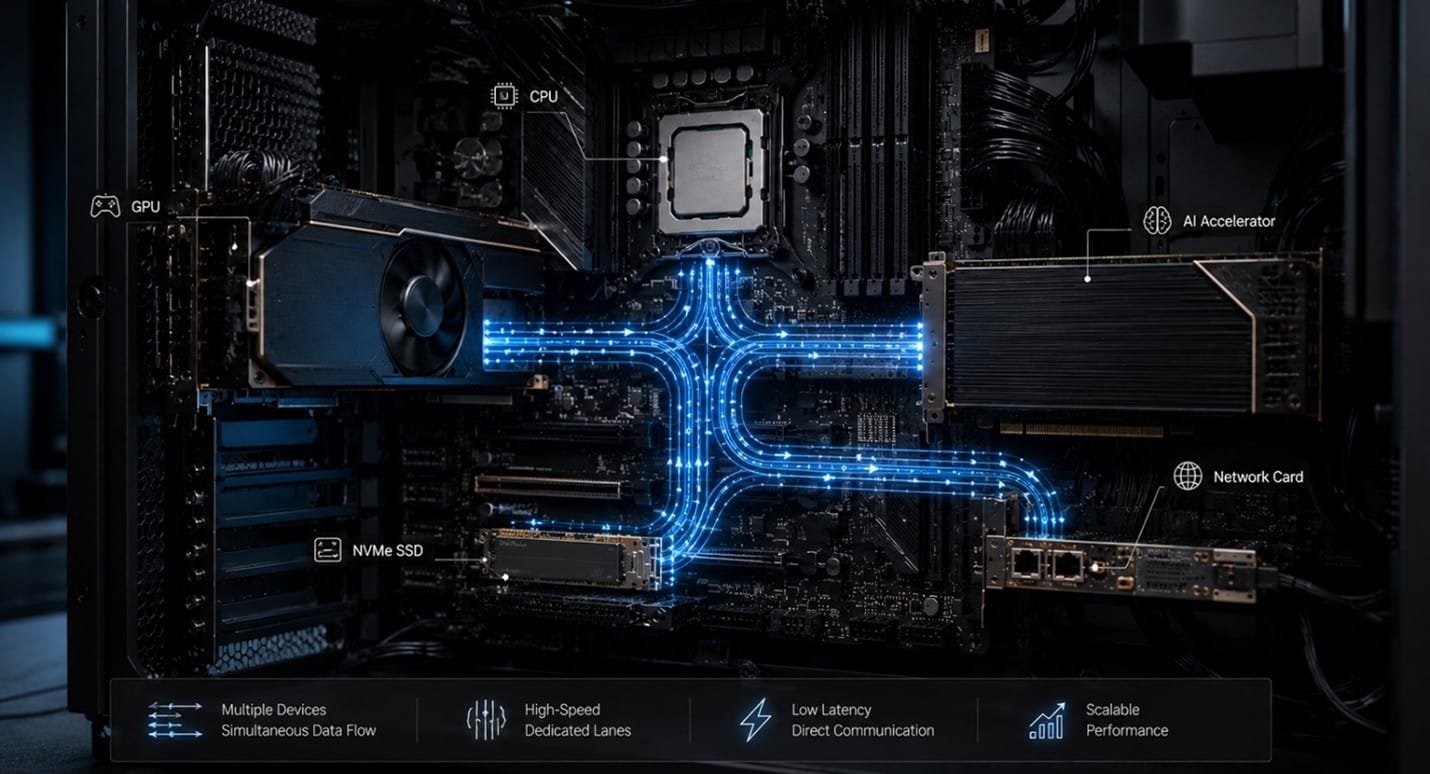
PCIe, short for Peripheral Component Interconnect Express, is the ultra fast connection system used inside modern computers. It allows hardware components such as graphics cards, NVMe SSDs, networking devices, and AI accelerators to communicate directly with the motherboard and processor at extremely high speeds.
With every new generation, PCIe significantly increases the amount of data that can move between components, allowing modern systems to handle increasingly demanding workloads more efficiently.
PCIe Bandwidth Evolution
| Generation PCIe 3.0 PCIe 4.0 PCIe 5.0 PCIe 6.0 PCIe 7.0 | Approximate Bandwidth 32 GB/s 64 GB/s 128 GB/s 256 GB/s 512 GB/s |
PCIe 7.0 effectively delivers sixteen times the bandwidth of PCIe 3.0, which was once considered cutting-edge.
Why PCIe 7.0 Matters
Modern computing is no longer driven by processing power alone. One of the biggest challenges today is moving massive amounts of data fast enough between hardware components without creating bottlenecks.
AI models, machine learning systems, 8K video editing, real time rendering, scientific simulations, and cloud infrastructure all rely heavily on extremely fast data transfer speeds. As workloads continue growing in size and complexity, traditional bandwidth limitations become a major issue.
PCIe 7.0 is designed to solve this problem by dramatically increasing the speed at which data can move across the system.
Key Advantages of PCIe 7.0
- Dramatically faster GPU-to-CPU communication
- Improved AI model training performance
- Reduced latency in high-performance workloads
- Faster next-generation NVMe SSD speeds
- Better scalability for data centers and enterprise systems
- Increased bandwidth for future multi-GPU systems
Instead of components waiting for data transfers to complete, PCIe 7.0 allows information to move almost instantly across the system.
The AI Industry Is Driving the Need for PCIe 7.0
Artificial intelligence is one of the biggest reasons PCIe technology is evolving so rapidly.
Modern AI systems process enormous datasets that must constantly move between:
- GPUs
- CPUs
- High-speed memory
- AI accelerators
- Network interfaces
- Storage arrays
As AI models continue growing in complexity, bandwidth limitations become a major performance barrier.
PCIe 7.0 helps remove major data transfer bottlenecks by enabling faster distributed AI training, improved inference performance, lower latency between accelerators, and more efficient large scale computing clusters. As AI systems continue processing increasingly massive datasets, faster communication between hardware components becomes critical for maintaining performance and efficiency.
This is especially important for companies building AI data centers, cloud computing infrastructure, autonomous systems, scientific computing platforms, and real time analytics environments. The future of AI is not only about having more powerful processors, but also about creating faster and smarter interconnects that allow hardware to communicate without delays.
What PCIe 7.0 Means for Gamers and PC Enthusiasts
For most everyday users, PCIe 7.0 will not instantly transform gaming performance, as current GPUs and SSDs are still far from fully utilizing the bandwidth offered by PCIe 5.0 in typical gaming workloads. However, future hardware generations are expected to benefit significantly from higher bandwidth, particularly in areas such as faster DirectStorage performance, reduced game loading times, larger open world asset streaming, improved VR and AR rendering, more advanced real time AI processing in games, and faster creator workflows for video editing and rendering. Professional workstations used for 3D rendering, simulations, AI assisted editing, and large media projects will likely see the advantages of PCIe 7.0 much earlier than mainstream gaming PCs.
PCIe 7.0 and Next-Generation SSDs
Storage technology is evolving rapidly, with modern PCIe 5.0 NVMe SSDs already exceeding 14 GB/s read speeds. PCIe 7.0 opens the door for even faster storage performance, which will be especially important for enterprise databases, AI dataset handling, 8K and 16K video production, scientific research, virtual machine environments, and real time analytics. As storage devices continue becoming faster, higher PCIe bandwidth will play a critical role in preventing system bottlenecks.
Power Consumption and Thermal Challenges
With higher speeds come greater engineering challenges. PCIe 7.0 systems will require improved motherboard signal integrity, better thermal management, higher quality PCB designs, advanced power delivery systems, and more sophisticated cooling solutions. At these extreme bandwidth levels, even tiny electrical inconsistencies can affect stability and performance, making system design significantly more complex.
Because of these requirements, PCIe 7.0 will initially appear in enterprise hardware, AI servers, high performance workstations, and large scale data center infrastructure before gradually becoming available in mainstream consumer systems as costs and manufacturing technologies improve.
Will You Need PCIe 7.0 Soon?
For most users today, upgrading to PCIe 7.0 is probably unnecessary. PCIe 4.0 and PCIe 5.0 already deliver excellent performance for gaming, content creation, and everyday computing, so average users are unlikely to notice major real world differences anytime soon.
However, industries working with AI, machine learning, cloud infrastructure, data science, and enterprise storage will likely adopt PCIe 7.0 much sooner as workloads continue growing. As always, smart upgrades matter more than simply chasing specifications.
The Bigger Picture: Computing Is Becoming Bandwidth-Limited
For years, computing performance was mostly about faster CPUs and GPUs. Today, bandwidth and data transfer speeds are becoming just as important. Future systems will rely heavily on faster interconnects, better memory bandwidth, and more efficient communication between hardware components.
PCIe 7.0 represents this shift toward data centric computing, where moving information faster directly improves AI, rendering, analytics, and other next generation workloads.
Final Thoughts
PCIe 7.0 marks another major step in the evolution of computing. While mainstream adoption will take time, it clearly shows where the industry is heading, with faster communication, larger datasets, and increasingly AI driven infrastructure.
For consumers, it means more future ready systems, while for businesses and AI providers, it lays the foundation for the next generation of high performance computing. At Focus PC, we help users understand when new technology genuinely matters and when upgrading too early simply is not worth the cost.